Verification
Constraint Random Coverage Driven Verification (CRCDV): An Engine Behind Modern Chip Verification
 July 11, 2026
 4 minutes read
 245 Views




Introduction
As semiconductor technology advances, modern System-on-Chip (SoC) designs have become increasingly complex. A single chip may integrate processors, memory controllers, communication interfaces, security modules, AI accelerators, and numerous peripherals. Each of these components can operate under multiple configurations, modes, and operating conditions.
The verification challenge is enormous. Verifying every possible combination using traditional directed test cases is neither practical nor scalable. As design complexity grows, the number of potential scenarios quickly reaches millions or even billions.
To address this challenge, the semiconductor industry adopted Constraint Random Coverage-Driven Verification (CRCDV), a methodology that has become the foundation of modern verification environments built using SystemVerilog and UVM.
CRCDV combines intelligent stimulus generation with measurable verification metrics, enabling engineers to explore large design spaces efficiently while maintaining confidence in verification completeness.
The Three Pillars of CRCDV
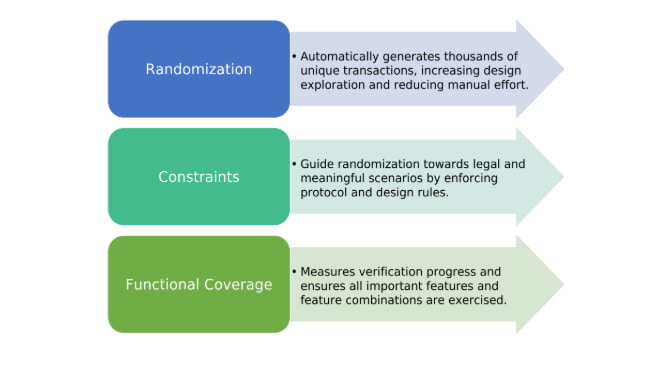
1. Randomization
Constraint randomization automatically generates a wide variety of input scenarios. Instead of manually creating individual testcases, engineers define transaction classes and allow the simulator to generate legal combinations.
With a single transaction definition, thousands of unique and legal scenarios can be generated automatically. Following are the benefits of randomization.
- Reduces manual test case development.
- Explores a larger verification space.
- Generates unexpected stimulus combinations.
- Increases bug-finding capability.
2. Constraints
Randomization without control can generate illegal or meaningless scenarios. Constraints help verification engineers to:
- Avoid illegal configurations.
- Focus on meaningful stimulus.
- Model protocol requirements.
- Improve simulation efficiency.
Proper constraint design is critical because over-constrained stimulus can hide bugs, while under-constrained stimulus may generate unrealistic scenarios.
3. Functional Coverage
Generating random stimuli alone does not guarantee verification completeness. Functional coverage measures which scenarios have been exercised during simulation.
Summary:
How does CRCDV Work?
The diagram represents the CRCDV flow, where stimulus generation is guided by coverage results until verification goals are achieved.
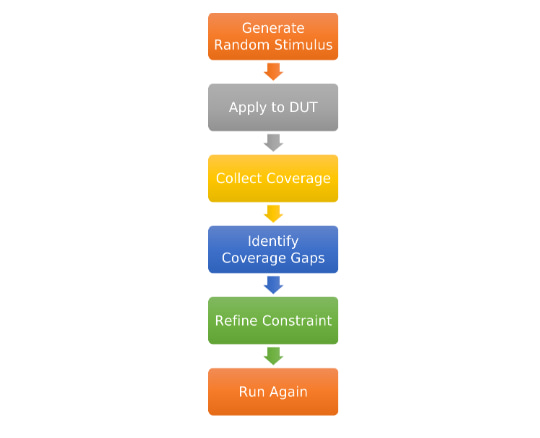
1. Generate Random Stimulus
- Random test vectors are generated using SystemVerilog constraints.
- The goal is to create a wide variety of legal scenarios automatically.
- Randomization helps uncover corner-case bugs that may be missed in directed testing.
- Constraints ensure only valid transactions are generated.
2. Apply to DUT
- Generated transactions are driven to the Design Under Test (DUT) through the verification environment.
- Drivers convert high-level transactions into pin-level activity.
- DUT responses are monitored and checked against expected behavior.
- Assertions and scoreboards validate correctness.
3. Collect Coverage
Coverage metrics are gathered during simulation.
Functional Coverage: Measures whether user-defined verification scenarios have been exercised. It checks address ranges, read/write operations, error conditions, protocol states, and corner-case scenarios.
Code Coverage: Measures RTL execution.
4. Identify Coverage Gaps
- Analyze coverage reports after simulation.
- Find uncovered scenarios or RTL regions.
- Determine why coverage is missing.
5. Refine Constraints
Based on uncovered scenarios:
- Modify randomization constraints.
- Add biasing (weighted distributions).
- Introduce targeted scenarios.
- Relax over-constraining conditions.
6. Run Again
- Re-run simulations with refined constraints.
- Generate new stimuli.
- Collect updated coverage.
- Repeat until coverage goals are met.
Typical stopping criteria: Functional Coverage = 100%, Code Coverage target achieved (e.g., 95–100%), Assertions passing.
Why Does It Matters ?
The biggest advantage of CRCDV is its ability to discover unexpected bugs. While directed tests verify expected behavior, constrained-random stimulus explores combinations that engineers may never think to test manually. Many silicon bugs are found in these rare corner-case interactions.
CRCDV and UVM
UVM is built around CRCDV principles. Sequences generate constrained-random transactions, monitors collect activity, scoreboards check correctness, and coverage collectors measure verification completeness, creating a scalable and reusable verification environment.
Conclusion
One of the greatest advantages of CRCDV is its ability to uncover bugs that engineers may never anticipate. Directed tests typically verify expected behavior. Constrained-random stimulus explores unexpected combinations of events, configurations, and timing interactions.
Many silicon escapes historically occurred due to corner-case interactions that were not considered during test case development. CRCDV significantly reduces this risk by systematically exploring a much larger verification space. For this reason, CRCDV has become the industry-standard methodology for verifying complex digital designs.
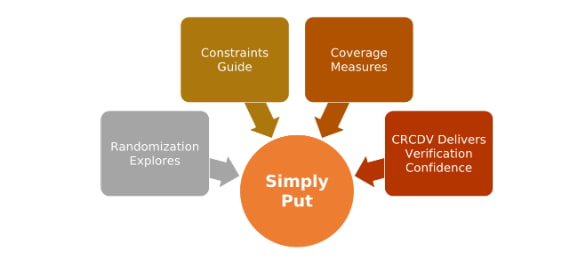
Summary:

Share This Post:


75,221
SUBSCRIBERS
Subscribe to our Blog
Get the latest VLSI news, updates, technical and interview resources
