Embedded Systems
ARM vs x86: The Architecture Battle Powering Your Laptop
 July 25, 2026
 6 minutes read
 259 Views




Every laptop you buy today—a Lenovo ThinkPad, an HP Pavilion, a gaming rig, or a MacBook — is built around a fundamental architectural choice made years before you ever open the lid: x86 or ARM. This isn’t a branding decision. It changes instruction design, core layout, power delivery, and thermal behavior at a silicon level. This post breaks down what’s actually different, why ARM has taken over mobile and is now pushing into laptops, and how power consumption ties back to architecture.
Two Instruction Set Philosophies
x86 (CISC – Complex Instruction Set Computer)
Used by Intel and AMD. Instructions are variable-length (1 to 15 bytes) and can encode complex operations (e.g., a single instruction that loads from memory, performs an operation, and stores the result). This reduces instruction count but increases decoder complexity — the CPU front-end needs sophisticated logic to figure out where one instruction ends and the next begins before it can even start decoding.
ARM (RISC – Reduced Instruction Set Computer)
Used by Apple Silicon, Qualcomm Snapdragon, and virtually all mobile SoCs. Instructions are fixed-length (32- bit, or 16/32-bit in Thumb mode), simple, and execute in fewer cycles. The decoder is simpler and cheaper in silicon area and power, and pipelines are easier to keep fed since instruction boundaries are predictable.
Why this matters for power: decode logic runs on every single instruction fetch. A simpler, fixed-length decode path burns meaningfully less energy per instruction — this is the seed of ARM’s efficiency advantage, though it’s not the whole story (see Section 3).
Who’s Building What — Mapped to Real Devices
| Device Category | Typical Chips | Architecture | Designer |
|---|---|---|---|
| Lenovo ThinkPad / IdeaPad (Mainstream) | Intel Core Ultra, AMD Ryzen | x86 | Intel / AMD |
| HP EliteBook / Pavilion (Mainstream) | Intel Core Ultra, AMD Ryzen | x86 | Intel / AMD |
| Newer Lenovo/HP “Copilot+ PC” Laptops | Snapdragon X Elite / X Plus | ARM | Qualcomm (ARM-licensed) |
| Gaming Laptops (Legion, Omen, ROG) | Intel Core i9/HX, AMD Ryzen HX + Discrete GPU | x86 | Intel / AMD (+ NVIDIA / AMD GPU) |
| Apple MacBook Air / Pro (M1–M3) | M1, M2, M3 | ARMv8.5-A / ARMv8.6-A | Apple (Custom Cores) |
| Apple MacBook Pro (M4 Onward) | M4 and Later | ARMv9.2-A | Apple (Custom Cores) |
| AMD Desktop / Laptop Chips | Ryzen (Zen 4 / Zen 5) | x86 | AMD |
Note: Apple’s transition to ARMv9 only began with the M4 (2024) to support SME2 (Scalable Matrix Extension 2) for on-device ML acceleration. M1 through M3 MacBooks all run ARMv8.x-A, not v9 — a detail that’s often glossed over.
It’s also worth noting the licensing distinction: Qualcomm licenses the ARM instruction set and builds its own core microarchitecture (Oryon), while Apple holds an ARM architectural license and designs its cores entirely in-house. Neither is simply “using an ARM chip” off the shelf—they’re building custom silicon around the ARM ISA. Intel and AMD, by contrast, both implement the x86-64 ISA but with independently designed microarchitectures (Intel’s Lion Cove/Skymont vs AMD’s Zen 5).
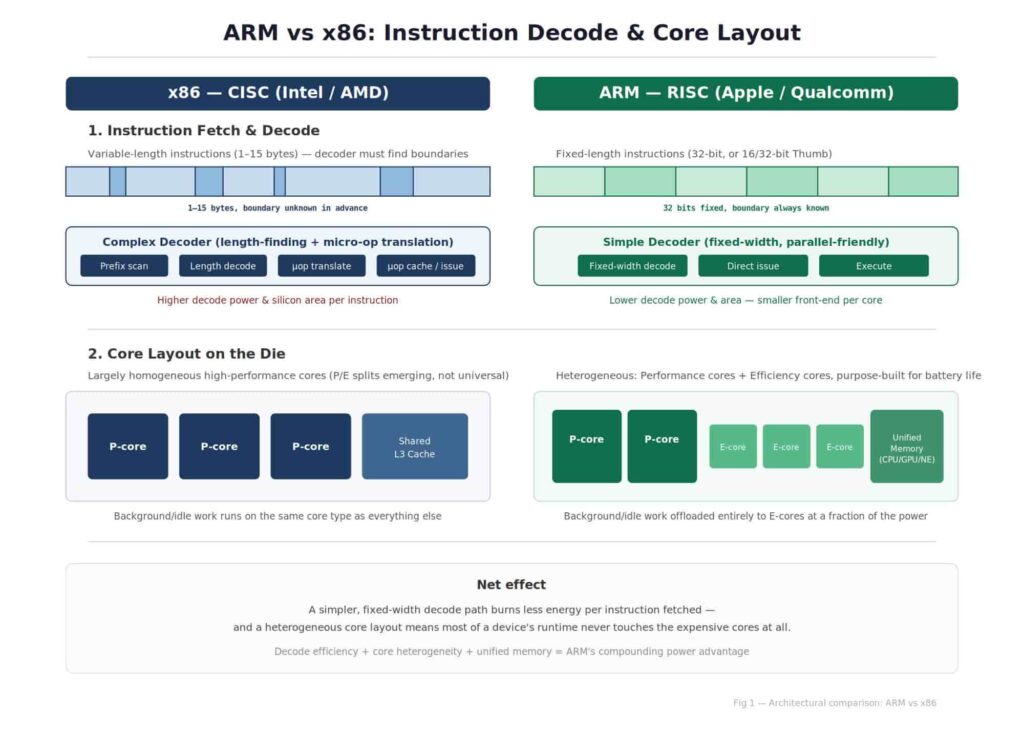
Fig1: Architectural Comparison of ARM and x86 Processor Designs
Why ARM Is Winning on Power
Four architectural factors compound to give ARM designs (especially Apple’s) a real power advantage, not just a decode-simplicity edge:
- Heterogeneous core design (big.LITTLE / P-cores & E-cores): ARM’s SoCs pair high-performance cores with small, efficient cores. Apple calls these Performance and Efficiency cores; background tasks run entirely on E-cores at a fraction of the power. Intel and AMD have adopted similar P/E-core splits recently, showing this idea isn’t ARM-exclusive — but ARM SoC vendors pioneered it for battery – powered devices first.
- Unified Memory Architecture (UMA): Apple Silicon puts CPU, GPU, and Neural Engine on the same physical memory pool with a shared address space. This eliminates power-hungry data copies across a PCIe bus to discrete VRAM — a real cost in traditional x86 laptop + discrete GPU setups.
- Process node advantage (correlated, not architectural): Apple’s M-series chips are usually first in line for TSMC’s newest node (3nm for M3/M4). A smaller node directly cuts dynamic power (P ∝ C·V²·f). This is a manufacturing-partnership advantage, not an ISA advantage — but it compounds with ISA efficiency.
- Aggressive DVFS and idle power gating: ARM SoCs designed for phones (and adapted for laptops) are tuned obsessively for idle and low-load power states. x86 chips, historically designed with desktops in mind, have had to retrofit this discipline — AMD and Intel’s mobile lines have closed much of this gap in the last 2-3 generations.
The honest caveat: ISA (RISC vs CISC) contributes a real but modest slice of the efficiency gap — modern x86 decoders use micro-op caches and fusion tricks to blunt the decode-power penalty. Most of Apple’s advantage comes from vertical integration: owning the core design, the SoC, the OS, and getting first access to the best process node. Qualcomm’s Snapdragon X on Windows shows solid but less dramatic gains over x86, partly because it lacks that same full-stack integration.
Gaming Laptops: A Different Power Equation Entirely
Gaming laptops (Legion, Omen, ROG) stay firmly on x86 for one reason: raw sustained throughput and GPU ecosystem, not efficiency. A discrete NVIDIA/AMD GPU alone can draw 80-175W under load — architectural CPU efficiency becomes a rounding error next to that. x86’s mature ecosystem (DirectX, Windows driver stack, decades of game engine optimization) and support for high sustained clocks under active cooling matter more here than instructions-per-watt. This is also why ARM hasn’t meaningfully entered gaming laptops yet — the software/driver ecosystem for AAA gaming isn’t there.
Quick Summary Table
| Factor | x86 (Intel/AMD) | ARM (Apple/Qualcomm) |
|---|---|---|
| Instruction set | Variable-length, CISC | Fixed-length, RISC |
| Typical use | Desktops, workstations, gaming laptops | Ultraportables, phones, tablets |
| Power efficiency | Improving, but higher idle draw | Strong, especially at idle/light load |
| Peak performance | Very high, sustained under active cooling | High, but thermally capped in fanless/thin designs |
| Software ecosystem | Mature (Windows-native) | Native on macOS; Windows-on-ARM still maturing |
| Core design | Licensed x86-64 by Intel/AMD only | Broad ecosystem — anyone with ARM license can design cores |
What’s Next
Windows-on-ARM (Snapdragon X) is the space to watch — Microsoft’s emulation layer (Prism) for running legacy x86 apps has matured a lot, and app-native ARM64 support is growing. Separately, RISC-V is emerging as a fully open, royalty-free ISA gaining traction in embedded and edge AI SoCs — a natural follow-up topic given ongoing work in embedded/Edge AI.

Share This Post:


75,221
SUBSCRIBERS
Subscribe to our Blog
Get the latest VLSI news, updates, technical and interview resources
