Embedded Systems
Embedded Systems vs IoT: Understanding the Difference | Complete Beginner Guide
 September 12, 2026
 7 minutes read
 243 Views




Table of Contents
- Introduction
- What Are Embedded Systems?
- What Is IoT (Internet of Things)?
- Embedded Systems vs IoT: Key Differences
- How Embedded Systems and IoT Work Together
- Real-World Applications of Embedded Systems and IoT
- Skills Required to Learn Embedded Systems and IoT
- Embedded Systems vs IoT: Which Career Path Is Better?
- Future Scope of Embedded Systems and IoT
- How to Get Started as a Beginner
- Conclusion
- Frequently Asked Questions
Key Takeaways
- Embedded systems run one dedicated task inside a device, from a washing machine to a car’s ABS module.
- IoT connects those devices to the internet so they can share data and be controlled remotely.
- Every IoT device relies on an embedded system, but not every embedded system needs the internet.
- Both fields share core skills, like C programming and hardware fundamentals..
Introduction
If you’ve browsed engineering forums or job portals, you’ve probably seen “embedded systems” and “IoT” used almost interchangeably. They’re related, but not the same thing, and mixing them up can cost you clarity when picking a course or a career.
Let’s clear that up. This guide breaks down what embedded systems actually are, the internet of things meaning in plain terms, and how the two connect.
What Are Embedded Systems?
An embedded system combines hardware and software built to perform one specific task within a larger device. Unlike your laptop, which juggles a browser, a game, and a spreadsheet at once, an embedded system does exactly one job, reliably, every time, like the controller inside your washing machine.
At its core sits a microcontroller or microprocessor, paired with memory, sensors, and input-output interfaces. The software, usually written in Embedded C, talks directly to this hardware, often without an operating system involved, which keeps things fast, predictable, and power efficient.
- Runs on limited hardware, so every line of code counts
- Works independently, with no need for internet connectivity
- Built for real-time performance, where delays mean malfunction
What Is IoT (Internet of Things)?
IoT, or the Internet of Things, refers to physical devices connected to the internet, capable of collecting, sending, and acting on data with little human involvement. Asking Alexa to switch off your bedroom lights is IoT in action.
Here’s the internet of things meaning in plain terms: everyday objects gain a way to talk to each other and to you, through sensors, connectivity modules, and cloud platforms. A smart thermostat sends its readings to a server, compares them against your preferences, and adjusts itself automatically.
Embedded Systems vs IoT: Key Differences
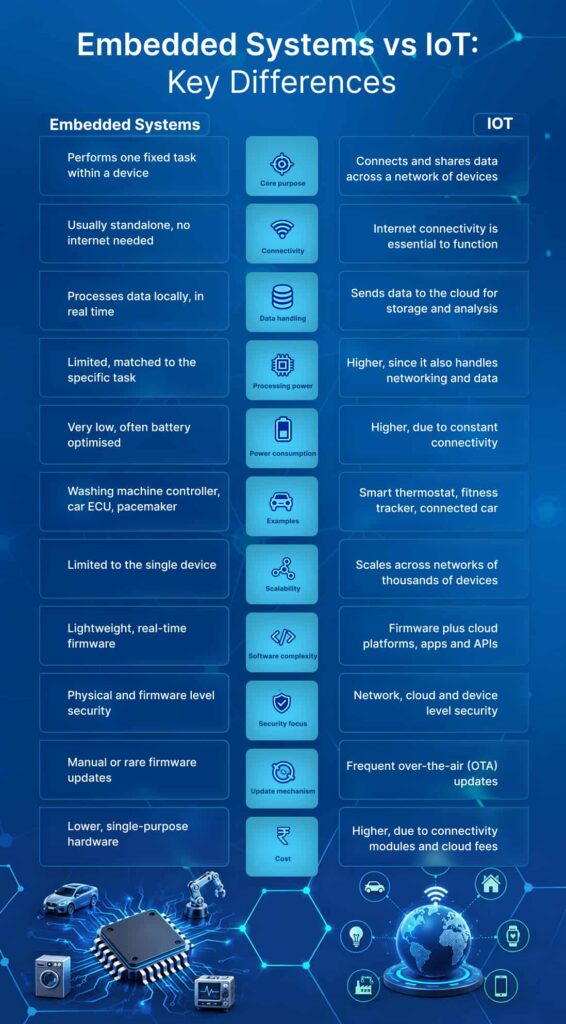
The table shows that embedded systems and IoT solve different problems, though they’re closely related. An embedded system can exist entirely on its own, quietly running your microwave without touching the internet. IoT, though, needs an embedded system as its foundation, since there’s nothing to connect without the hardware underneath.
How Embedded Systems and IoT Work Together
Every IoT device is, at its heart, an embedded system with added connectivity. Take a smart irrigation system: the embedded system handles moisture sensing and valve control in real time, while the IoT layer sends that data to a farmer’s phone for remote adjustments.
- Embedded hardware collects and processes sensor data locally
- Connectivity modules, like Wi-Fi or LoRa, push data onward
- Cloud platforms store, analyse, and visualise the information
This layered approach is why engineers who understand both hardware and connectivity are in demand. Maven Silicon’s Embedded System Design with Embedded Linux and IoT course covers exactly this stack, from firmware to connected devices.
Real-World Applications of Embedded Systems and IoT
- Healthcare: Embedded systems power pacemakers, insulin pumps, and ventilators, running precisely and independently to keep patients safe, with zero tolerance for delay. IoT builds on this with wearables and remote patient monitors that stream heart rate, oxygen levels, and glucose readings to doctors in real time, letting hospitals track chronic conditions and flag emergencies without the patient stepping into a clinic.
- Automotive: A modern car runs dozens of embedded systems at once, from the engine control unit and anti-lock brakes to airbag deployment and power steering, each handling one job with split-second precision. Connected cars layer IoT on top, enabling live traffic rerouting, remote diagnostics, over-the-air software updates, and even predictive alerts before a part actually fails.
- Smart homes: Embedded controllers quietly run individual appliances, your washing machine, air conditioner, or microwave, each with its own dedicated chip. IoT ties these separate devices together through a central hub, so your thermostat, smart lock, and security camera all talk to one app, letting you monitor and automate your home from anywhere.
- Industrial automation: Factories depend on embedded systems for precise, real-time control of robotic arms, conveyor belts, and safety interlocks on the shop floor. IoT extends this into predictive maintenance, where sensors track vibration, temperature, and wear on machinery, flagging issues days before a breakdown and saving costly downtime.
- Agriculture: Embedded sensors measure soil moisture, temperature, and nutrient levels directly in the field, processing readings locally without any need for connectivity. IoT connects these readings to farm management platforms, helping farmers automate irrigation, track crop health remotely, and make data driven planting decisions from a phone, even miles away from the field.
Skills Required to Learn Embedded Systems and IoT
- Embedded C and C++: non-negotiable, since firmware runs close to the hardware.
- Microcontrollers: understand ARM architecture, registers, interrupts, and memory management.
- RTOS concepts: many applications need predictable timing and strict deadlines.
- Protocols: UART, SPI, and I2C for hardware, plus MQTT and HTTP for connectivity.
- Cloud platforms: a good IoT course covers AWS IoT or Azure IoT basics, where device data eventually lands.
- Linux fundamentals: embedded and IoT devices increasingly run on Embedded Linux.
If you’re weighing your next step, Maven Silicon’s Embedded C Programming course builds exactly this foundation.
Embedded Systems vs IoT: Which Career Path Is Better?
| Aspect | Embedded Systems Career | IoT Career |
|---|---|---|
| Typical roles | Firmware engineer, embedded software developer, hardware-software integration engineer | IoT solutions architect, IoT developer, connected product engineer |
| Industry demand | Steady and consistent, core to electronics, automotive and semiconductors | Rapidly growing, spans nearly every industry vertical |
| Entry point | Strong C programming and hardware fundamentals | Embedded basics plus networking and cloud fundamentals |
| Learning curve | Moderate, hardware and firmware focused | Slightly steeper, spans hardware, networking and cloud |
| Key hiring sectors | Semiconductor firms, automotive, medical devices, aerospace | Smart cities, industrial automation, consumer tech, agritech |
| Work environment | Hardware labs, hands-on debugging and testing | Mix of hardware, cloud dashboards and app layers |
| Useful certifications | ARM Accredited Engineer, Embedded C, RTOS training | AWS IoT, Azure IoT, industry IoT protocol certifications |
| Career growth path | Senior firmware engineer, embedded architect, chip design lead | IoT architect, platform lead, connected solutions consultant |
| Long-term scope | Deep specialisation in chip level and firmware design | Broader exposure across connected, data driven ecosystems |
There’s no universally better choice. If you enjoy working close to hardware, embedded systems careers offer deep, specialized growth. If you’re drawn to the bigger picture of connecting devices and platforms, an IoT career gives you that breadth. Many engineers, understandably, end up doing both.
Future Scope of Embedded Systems and IoT
The road ahead looks promising for both fields. According to IoT Analytics, connected IoT devices reached roughly 18.5 billion in 2024, growing 14 percent year on year toward 21.1 billion by 2025. Meanwhile, Grand View Research values the embedded systems market at USD 112.3 billion in 2024, projected to reach USD 169.1 billion by 2030. With AI at the edge and 5G expanding, an IoT career and embedded systems roles are both set to grow steadily.
How to Get Started as a Beginner
- Learn C programming and basic electronics first
- Pick a microcontroller board, like an Arduino or STM32, and get hands-on
- Build small projects: an LED blinker, a temperature logger, a home automation setup
- Learn one communication protocol thoroughly rather than skimming five
- Explore a structured embedded systems course for guided projects
Conclusion
Embedded systems and IoT aren’t rivals, they’re partners. One handles hardware level intelligence, the other extends it across networks. Whichever direction excites you more, the foundation stays the same: strong C programming and hands-on project experience.
Explore Maven Silicon’s Embedded System Design course, built with industry tools, real projects, and placement support to get you job ready.

Share This Post:


75,221
SUBSCRIBERS
Subscribe to our Blog
Get the latest VLSI news, updates, technical and interview resources
