SoC Design
Network-on-Chip (NoC): The Communication Backbone of Modern SoCs
 June 8, 2026
 3 minutes read
 88 Views




Introduction
The semiconductor industry has evolved dramatically over the past two decades. Earlier integrated circuits contained only a few processing blocks connected through simple buses. Today, modern System-on-Chip (SoC) devices integrate CPUs, GPUs, AI accelerators, memory controllers, DSPs, security engines, multimedia processors, and numerous peripherals onto a single chip.
As the number of integrated components increases, communication between these blocks becomes one of the biggest design challenges. Traditional shared-bus architectures struggle to handle the growing demand for bandwidth, scalability, and power efficiency.
To overcome these limitations, the semiconductor industry introduced Network-on-Chip (NoC): a scalable and high-performance communication architecture inspired by computer networking concepts.
NoC has now become a fundamental building block in advanced SoC architectures, especially in AI processors, mobile chips, automotive electronics, networking devices, and high-performance computing systems.
What is Network-on-Chip (NoC)?
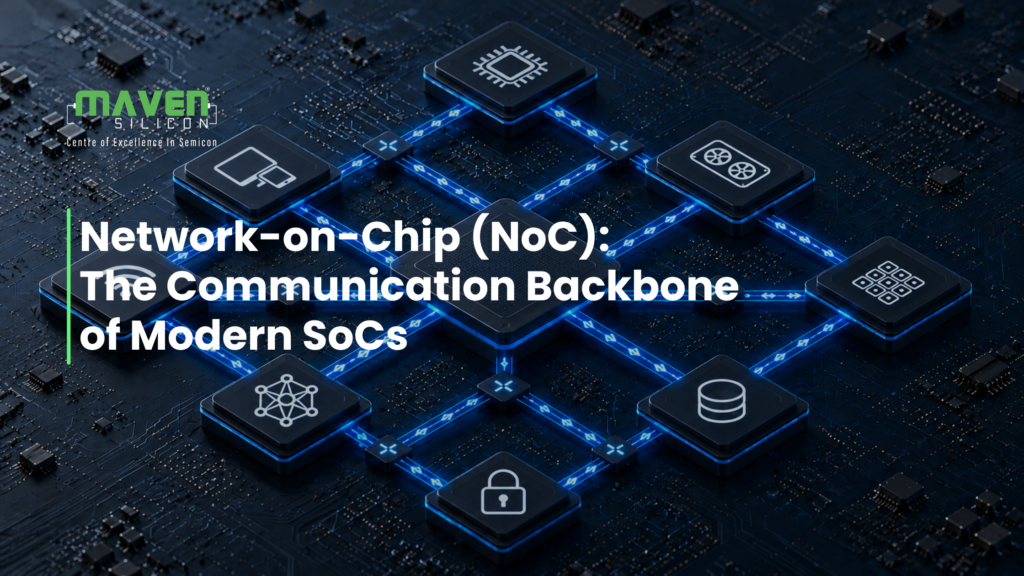
Network-on-Chip (NoC) is an on-chip communication framework that enables data exchange between different IP blocks using packet-based communication.
Instead of transferring information over a single shared bus, NoC organises communication using:
- Routers
- Switches
- Interconnect links
- Packetized data transfer
- Routing algorithms
Each IP block acts like a node in a network, communicating with other blocks through structured data paths.
In simple words: NoC works like an internal communication network inside the chip.
Why NoC is Important
Scalability
Modern SoCs may contain dozens of cores and accelerators. NoC allows easy expansion without major redesign challenges.
Higher Bandwidth
Multiple communication paths enable parallel data transfer, improving throughput for AI, graphics, and high-performance applications.
Reduced Congestion
Advanced routing techniques distribute traffic efficiently and minimise bottlenecks inside the chip.
Better Power Efficiency
NoC reduces long-wire switching activity and supports power-saving techniques such as clock gating and DVFS.
Easier Timing Closure
Breaking communication into smaller router-to-router hops helps manage timing more effectively in advanced technology nodes.
Basic Components of NoC
A typical NoC architecture includes:
- Routers for packet forwarding
- Links for data transfer
- Network Interfaces for protocol conversion
- Topologies such as Mesh, Ring, and Torus
Among these, Mesh topology is widely used because of its simplicity and scalability
NoC in Modern Applications
NoC plays a major role in:
- AI and Machine Learning processors
- Smartphone SoCs
- Automotive electronics
- Data-centre accelerators
- High-performance computing systems
It is especially critical in AI chips where massive parallel data movement is required.
Challenges in NoC Design
Although NoC offers many benefits, designers must still address:
- Router complexity
- Latency optimization
- Power overhead
- Deadlock prevention
- Verification challenges
Efficient NoC design requires careful architectural planning and traffic analysis.
Future of NoC
Future semiconductor systems will rely even more on advanced NoC technologies, such as:
- Wireless NoC
- Optical NoC
- AI-based adaptive routing
- Chiplet interconnect fabrics
These innovations will further improve scalability and communication efficiency.
Conclusion
Network-on-Chip has become a foundational technology in modern SoC design. It solves the limitations of traditional bus architectures by providing scalable, high-bandwidth, and power-efficient communication between multiple processing blocks.
As chips continue to grow in complexity, NoC will remain a key enabler for next-generation semiconductor systems, making it an essential topic for every VLSI and SoC engineer to understand.

Share This Post:


75,221
SUBSCRIBERS
Subscribe to our Blog
Get the latest VLSI news, updates, technical and interview resources
