Embedded Systems
Embedded AI in IoT Smart Devices: How It Works and Key Benefits
 September 17, 2026
 5 minutes read
 246 Views




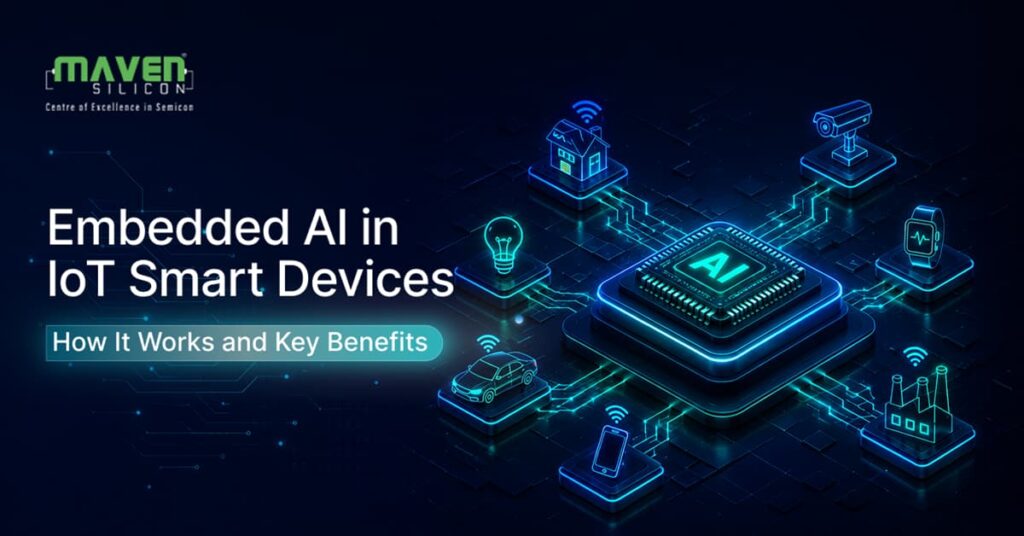
Table of Contents
- Why Is Embedded AI Rising Across the Globe?
- How Does Embedded AI Work in IoT Devices?
- What Are the Benefits of Embedded AI in IoT?
- Where Is Embedded AI Used in the Real World?
- What Skills Do You Need to Build Embedded AI Systems?
- What Challenges Should You Expect?
- What Does the Future Hold for 2025 and Beyond?
- Where Should You Go From Here With Maven Silicon?
Key Takeaways
- Embedded AI runs ML models on-chip for instant, local decisions.
- Global IoT connections are projected to almost double by 2030, pushing demand for on-device intelligence higher.
- The edge AI market is expanding rapidly through the next decade, confirming this is not a passing trend.
- Real-time response, stronger privacy, and lower running costs are the biggest wins for adopters.
- Building these systems needs a mix of embedded engineering and AI skills, a combination in short supply.
Introduction
Your smart thermostat just decided you were cold before you reached for the dial. No cloud round trip, just a chip reacting in milliseconds. That is embedded AI at work, quietly changing how everyday connected devices sense, decide, and act on their own. Here is how it works, why it matters, and what it takes to build.
Why is Embedded AI Rising Across the Globe?
The world keeps filling with connected sensors, and sending every byte to the cloud does not scale. IoT Analytics reports connected IoT devices reached 18.5 billion in 2024 and are expected to climb to 39 billion by 2030, forcing engineers to rethink where computation happens.
- Cloud latency is unacceptable for safety-critical tasks like braking.
- Data privacy rules push processing closer to the source.
- Cheaper microcontrollers now make on-chip inference realistic.
- Better connectivity has not removed the need for local intelligence.
How Does Embedded AI Work in IoT Devices?
Embedded AI is a compact pipeline on a resource-constrained chip. It borrows from traditional embedded machine learning practice but trims every unnecessary byte to fit tight memory and power budgets.
- Sensing and Data Capture: Sensors gather raw signals such as temperature, vibration, or audio, filtered right at the source.
- On-Device Model Inference: A compressed model runs directly on the microcontroller, interpreting data without a server call.
- Decision and Action: The device triggers an action, an alert or a display update, within milliseconds.
- Continuous Learning Loop: Some systems periodically sync summarised data to the cloud, refining the model without exposing raw data.
What Are the Benefits of Embedded AI in IoT?
Strip away the buzzwords, and the value is practical.
- Faster, Real-Time Decisions: No round trip to a remote server, so response times drop from seconds to milliseconds.
- Better Privacy and Security: Sensitive data stays on the device instead of travelling across networks.
- Lower Bandwidth and Running Costs: Only meaningful data gets transmitted, cutting storage bills.
- Reliable Offline Operation: Devices keep working even when connectivity drops, which matters in remote settings.
- Sharper AI algorithms at the edge let devices adapt to their own environment, not a generic cloud model.
Where Is Embedded AI Used in the Real World?
This is already shaping products you use every day.
- Wearables that detect irregular heart rhythms instantly.
- Industrial sensors that predict machine failure before it happens.
- Smart agriculture systems that adjust irrigation from live soil readings.
- Automotive ADAS features like lane departure warnings.
- Smart home devices that recognise faces and sounds locally.
These IoT smart devices share one trait: they think for themselves rather than waiting on a distant data centre.
What Skills Do You Need to Build Embedded AI Systems?
Building these systems needs a genuine blend of hardware depth and AI fluency.
| Skill Area | Why It Matters |
|---|---|
| Embedded C and RTOS | Controls hardware behaviour and timing on constrained devices |
| Microcontroller and SoC design | Sets the compute and memory budget you work within |
| Model compression (TinyML) | Shrinks AI models to fit tiny memory footprints |
| Sensor interfacing and protocols | Connects real-world signals, like I2C or SPI, to the pipeline |
| RISC-V or ARM architecture | Forms the processing core most edge AI chips are built on |
This blend of hardware know-how and applied embedded learning is what employers are chasing right now. Maven Silicon’s Embedded Systems Design course covers these fundamentals through hands-on labs, and learners exploring processor-level design often pair it with the RISC-V IP Design programme to understand the silicon underneath.
What Challenges Should You Expect?
Nothing useful comes without trade-offs.
- Power and memory constraints force compromises on model accuracy.
- Security patching is harder across thousands of scattered devices.
- Debugging constrained hardware needs different tools.
- The talent gap is real, few graduates learn embedded systems and AI together.
A structured Embedded Systems Internship helps close that gap, giving learners real project experience before they job hunt.
What Does the Future Hold for 2025 and Beyond?
The trajectory is clearly upward. Grand View Research values the global edge AI market at USD 24.9 billion in 2025, projecting it to reach USD 118.7 billion by 2033.
- TinyML will keep shrinking models without losing accuracy.
- RISC-V chips will gain ground as an open option for AI workloads.
- Federated learning will let devices improve collectively while keeping data private.
- Sustainability pressure will push chipmakers toward lower power chips.
Where Should You Go From Here With Maven Silicon?
Embedded AI is fast becoming a baseline expectation for engineers working on IoT smart devices, not a niche specialisation. Whether you are an ECE graduate, a professional switching tracks, or a company upskilling a team, now is the moment. At Maven Silicon, we have spent years closing the gap between engineering theory and industry-ready skill, with programmes built around real tools, projects, and placement support.
See the Embedded Systems Design course, or get in touch about corporate training for teams.
Reference links :-
https://iot-analytics.com/number-connected-iot-devices/
https://www.grandviewresearch.com/industry-analysis/edge-ai-market-report

Share This Post:


75,221
SUBSCRIBERS
Subscribe to our Blog
Get the latest VLSI news, updates, technical and interview resources
